 EN
EN

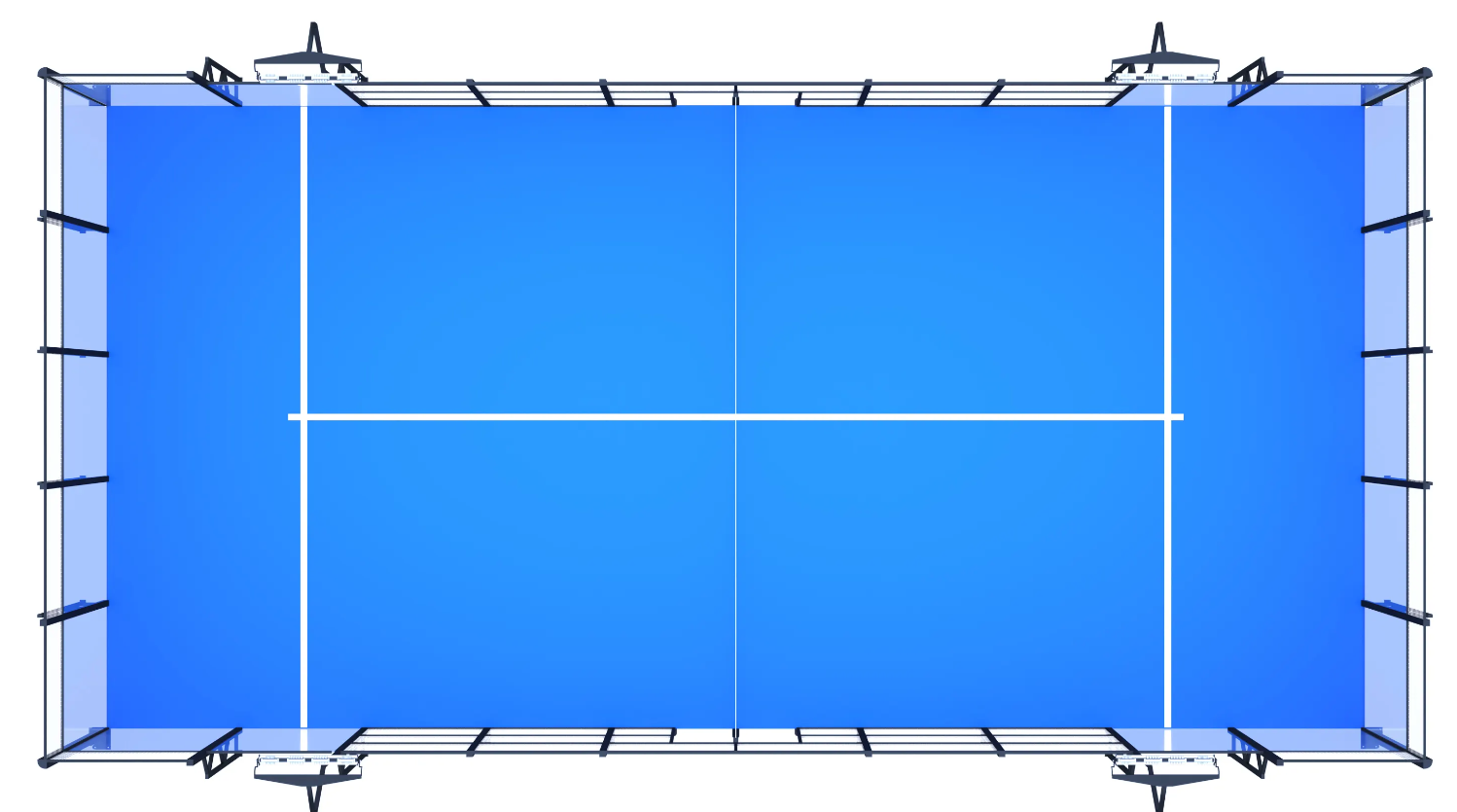
Understanding Padel Court Construction and Structural Requirements
Key Phases in Padel Court Construction
Padel court construction follows a systematic five-phase process:
- Excavation and drainage preparation to ensure water runoff and ground stability
- Reinforced concrete base installation with steel beams for structural integrity
- Wall assembly using 12mm tempered glass and galvanized steel frames
- Surface application of UV-stabilized artificial turf with sand infill
- Safety integration of padded walls and anti-slip perimeter markings
Importance of Adhering to Official Padel Court Dimensions and Space Requirements
Regulation padel courts measure 20m x 10m (65.6ft x 32.8ft) with 3m (9.8ft) vertical clearance. Deviations exceeding 0.5% compromise gameplay mechanics – undersized courts reduce shot angles by 15–22% [2023 Racquet Sports Engineering Report]. Outdoor installations require an additional 4m (13.1ft) perimeter buffer to meet safety protocols set by the International Padel Federation.
Role of Structural Materials in Long-Term Durability
Material selection directly influences longevity and performance:
| Component | Premium Materials | Average Lifespan | Common Failure Points |
|---|---|---|---|
| Base | Fiber-reinforced concrete | 25+ years | Cracks from frost heave |
| Walls | Laminated safety glass | 15–20 years | Sealant degradation |
| Surface | Polypropylene hybrid turf | 8–12 years | UV degradation & fiber matting |
Using high-grade materials ensures resilience against environmental stressors and reduces lifecycle costs.
Integration of Safety Features During Construction
Modern padel courts incorporate three integrated protective layers:
- Impact-absorbing walls: 30mm EVA foam padding reduces collision injuries by 63%
- Surface shock pads: 8mm rubber underlay meets HIC (Head Injury Criterion) ≤ 1,200
- Perimeter drainage: Sloped channels prevent 92% of slip-related accidents (World Court Safety Institute 2022)
Proper sequencing is critical—installing drainage before surface application prevents water accumulation beneath shock-absorbing layers, preserving both safety and structural integrity.
Evaluating Location and Environmental Factors for Optimal Site Selection
Assessing sun exposure and wind patterns for player comfort
Orienting courts along a north-south axis minimizes direct sunlight during peak hours, reducing glare and heat stress. Strategic placement of windbreaks—such as mesh fencing or vegetation—helps mitigate disruptive crosswinds. In Mediterranean climates, retractable canopies increase summer utilization by 23% by providing adjustable shade (Sports Venue Safety Report 2023).
Drainage and ground stability considerations for outdoor padel courts
A slope gradient of 1–2% combined with permeable base layers like crushed granite prevents water pooling, which accounts for 42% of premature artificial turf replacements (Court Surface Institute 2022). The Site Selection Guidelines for Athletic Facilities recommend geotechnical surveys prior to construction to assess soil compaction needs, especially when installing shock-absorbent surfaces.
Indoor vs. outdoor padel court considerations based on climate and usage
Padel courts located in drier areas where annual rainfall stays below 800mm tend to stay intact about 78 percent longer compared to their counterparts near the coast where humidity is high, according to research published by the Global Padel Council back in 2023. Building indoor facilities comes at a steeper price tag right from the start, roughly 40% more expensive when factoring in all the climate control systems and stronger structural requirements needed for these spaces. But this upfront cost pays off because people can play throughout the year even in places with moderate climates. There's also something called hybrid court designs that feature removable roof sections which strikes a nice middle ground between full outdoor exposure and complete enclosure, letting players enjoy fresh air while still being protected against sudden rain showers or harsh sun.
Comparing Padel Court Surface Materials and Their Impact on Playability
Types of Padel Court Flooring Materials and Their Impact on Gameplay and Ball Bounce
There are four main kinds of surfaces commonly found on sports fields these days: artificial turf, acrylic coatings, polyurethane materials, and porous concrete options. The artificial turf variety filled with silica sand remains the favorite among pros because balls tend to slow down after bouncing off it around 12 to 15 percent less than they would on acrylic surfaces. Players also appreciate how predictably the ball moves sideways across this type of turf. Acrylic surfaces let the game move at a quicker pace since the ball bounces pretty consistently each time it hits the ground, usually reaching heights between 75 and 85 centimeters. Polyurethane surfaces have become popular for casual indoor games where protecting joints matters more than speed. Porous concrete might last longer than other options, but nobody wants to compete on it since the ball just doesn't travel reliably from one spot to another, making it practically useless for anything serious.
Artificial Turf for Padel Courts: Benefits and Limitations
Fibrillated turf systems reduce joint impact by 18–22% compared to hard surfaces (Sports Surface Safety Council 2023), maintaining consistency through optimal sand infill (2,800–3,200 kg per court). However, weekly brushing and seasonal sand redistribution increase lifetime maintenance costs by 30–40% versus low-maintenance acrylic alternatives.
Shock Absorption and Player Safety in Court Surfaces
| Surface Type | Vertical Deformation | Injury Risk Reduction |
|---|---|---|
| Polyurethane | 8–10 mm | 45–50% |
| Artificial Turf | 5–7 mm | 30–35% |
| Acrylic | 2–3 mm | 10–15% |
Surfaces with over 6 mm deformation significantly lower lower-body injury risks, making textured turf with elastic underlays the preferred choice in European junior academies.
Ball Bounce and Playability by Surface Type: A Comparative Analysis
Surface hardness directly affects ball behavior. World Padel Tour-regulated acrylic courts produce bounces of 82–88 cm at 23°C. Artificial turf shows 5–8% variation depending on sand compaction, while aged polyurethane can develop "dead zones" with bounce deviations of 15–20 cm, affecting shot predictability.
Synthetic vs. Porous Surfaces: Performance and Controversy in Professional Circuits
At the 2023 Padel Masters final, organizers made the switch from old school monofilament turf to this new hybrid acrylic stuff. What happened next was interesting - serves started flying across the court about 12% quicker on average reaching around 198 km/h, but players were making roughly 18% more mistakes they shouldn't be making. Wet weather problems have been a real issue for porous surfaces lately, so no surprise these types of courts are disappearing from top level competitions. The latest synthetic turf coming onto the scene features those neat vertically aligned fibers that manufacturers claim are changing the game. Courts built with this material boast nearly perfect ball bounce consistency at 94%, plus better footing for pros who need stability during intense matches.
Optimizing Player Experience Through Design and Layout Planning
Linking Player Safety and Comfort to Surface and Structural Choices
When it comes to keeping players safe, what materials we choose matters a lot. Surfaces that have just the right amount of texture can cut down slip accidents by around 23%, according to research from the International Padel Federation back in 2023, and they still allow for quick movements during play. Wall panels need to be made of tempered safety glass at least 4mm thick if they're going to hold up against those hard hits from balls flying at speed. And when setting something up outside, especially near the coast where salt air eats away at metal so fast, going with galvanized steel frames plus some good quality anti-corrosion coating makes all the difference for lasting performance over time.
Designing for Intended Use: Casual Recreation vs. Professional Training
Recreational courts often use cost-effective synthetic turf with maintenance costs between $18–$28/sqm. In contrast, competition-grade facilities employ hybrid grass systems to meet FIP-certified standards for ball rebound consistency. Professional layouts also include 10–12% extra perimeter space for referees and camera positions—features typically omitted in casual setups.
Influence of Court Texture on Foot Traction and Movement Efficiency
Traction varies significantly across surface textures:
| Texture Type | Friction Coefficient | Ideal Use Case |
|---|---|---|
| Smooth | 0.65–0.72 | Indoor clubs |
| Ribbed | 0.78–0.85 | Coastal areas |
| Granular | 0.82–0.91 | Tournament |
| Hybrid | 0.75–0.80 | Multi-climate |
Granular surfaces allow 19% faster recovery after lateral movements in controlled trials, enhancing performance in high-intensity matches.
Padel Court Layout Planning for Space Efficiency and Zoning
While regulation courts require a 20m x 10m footprint, urban developments increasingly adopt retractable net systems to share space with tennis courts. Strategically placed glass panels improve spectator visibility without sacrificing playability—a design approach used in 68% of new Spanish sports complexes.
Zoning for Player Access, Seating, and Equipment Storage
A 1.2–1.5m perimeter buffer zone prevents collisions with boundary fencing and accommodates bench seating. Overhead storage racks above entry points maximize floor efficiency, holding up to 12 paddles and 40 balls per square meter. Dual-access gates streamline player rotation during tournaments, cutting match transition times by 8–12 minutes.
Cost, Maintenance, and Long-Term Sustainability of Padel Courts
Cost Considerations for Padel Court Installation and Material Selection
Initial installation costs range from €18,000 to €20,000, influenced by materials, location, and zoning regulations. Outdoor courts generally require 15–20% less capital than indoor equivalents, which need climate control and structural reinforcements. Although artificial turf has a lower upfront cost than porous concrete, its shorter lifespan may lead to earlier replacement.
| Cost Factor | Average Range | Key Influencers |
|---|---|---|
| Installation | €18,000 – €20,000 | Materials, location, zoning |
| Annual Maintenance | €2,000 – €10,000 | Surface type, climate, usage |
Maintenance Requirements of Different Court Surfaces Over Time
Artificial turf requires monthly brushing and annual infill top-ups to preserve performance. Resin-based surfaces need biannual anti-slip treatments, while concrete courts demand semi-annual crack inspections. Studies show that consistent maintenance extends turf lifespan from 4 to 6 years, reducing long-term replacement expenses by 30%.
Minimizing Downtime and Long-Term Expenses Through Proactive Maintenance
Quarterly inspections of drainage and fencing prevent 80% of weather-related damage in outdoor courts. Daily cleaning routines reduce surface abrasion by 40%, according to industry maintenance reports. Climate-specific measures—such as UV-protective sealants in sunny regions—can lower annual repair costs by up to €1,200.
Budget and Location Alignment for Sustainable Padel Court Investment
High-salinity coastal environments necessitate corrosion-resistant galvanized steel frames, increasing initial costs by 10–15% but drastically reducing upkeep. Urban sites benefit from modular construction, which cuts building waste by 25%. Lifecycle analyses confirm recycled rubber surfaces reduce carbon emissions by 18% without compromising play quality, supporting sustainable development goals.
FAQ
What are the official dimensions for a padel court?
Official padel courts measure 20m x 10m (65.6ft x 32.8ft), with a vertical clearance of 3m (9.8ft). These dimensions are crucial for maintaining gameplay integrity.
What materials are recommended for the construction of durable padel courts?
Premium materials recommended include fiber-reinforced concrete for the base, laminated safety glass for walls, and polypropylene hybrid turf for the surface. These materials ensure long-term durability and performance.
How does surface texture impact player performance?
Surface texture affects friction and traction, essential for player movement and safety. Granular textures help enhance performance in high-intensity matches, allowing faster recovery after lateral movements.
How can padel courts be maintained to ensure long-term sustainability?
Consistent maintenance is crucial. Monthly cleaning routines reduce surface abrasion, while quarterly inspections prevent weather-related damage, thereby extending the court's lifespan and reducing long-term expenses.
Indoor vs. outdoor padel courts: which is more cost-effective?
While outdoor courts are initially cheaper, indoor courts offer year-round usage, especially in moderate climates. However, they require additional upfront investment for climate control systems and structural reinforcements.
Table of Contents
- Understanding Padel Court Construction and Structural Requirements
- Evaluating Location and Environmental Factors for Optimal Site Selection
-
Comparing Padel Court Surface Materials and Their Impact on Playability
- Types of Padel Court Flooring Materials and Their Impact on Gameplay and Ball Bounce
- Artificial Turf for Padel Courts: Benefits and Limitations
- Shock Absorption and Player Safety in Court Surfaces
- Ball Bounce and Playability by Surface Type: A Comparative Analysis
- Synthetic vs. Porous Surfaces: Performance and Controversy in Professional Circuits
-
Optimizing Player Experience Through Design and Layout Planning
- Linking Player Safety and Comfort to Surface and Structural Choices
- Designing for Intended Use: Casual Recreation vs. Professional Training
- Influence of Court Texture on Foot Traction and Movement Efficiency
- Padel Court Layout Planning for Space Efficiency and Zoning
- Zoning for Player Access, Seating, and Equipment Storage
- Cost, Maintenance, and Long-Term Sustainability of Padel Courts
-
FAQ
- What are the official dimensions for a padel court?
- What materials are recommended for the construction of durable padel courts?
- How does surface texture impact player performance?
- How can padel courts be maintained to ensure long-term sustainability?
- Indoor vs. outdoor padel courts: which is more cost-effective?